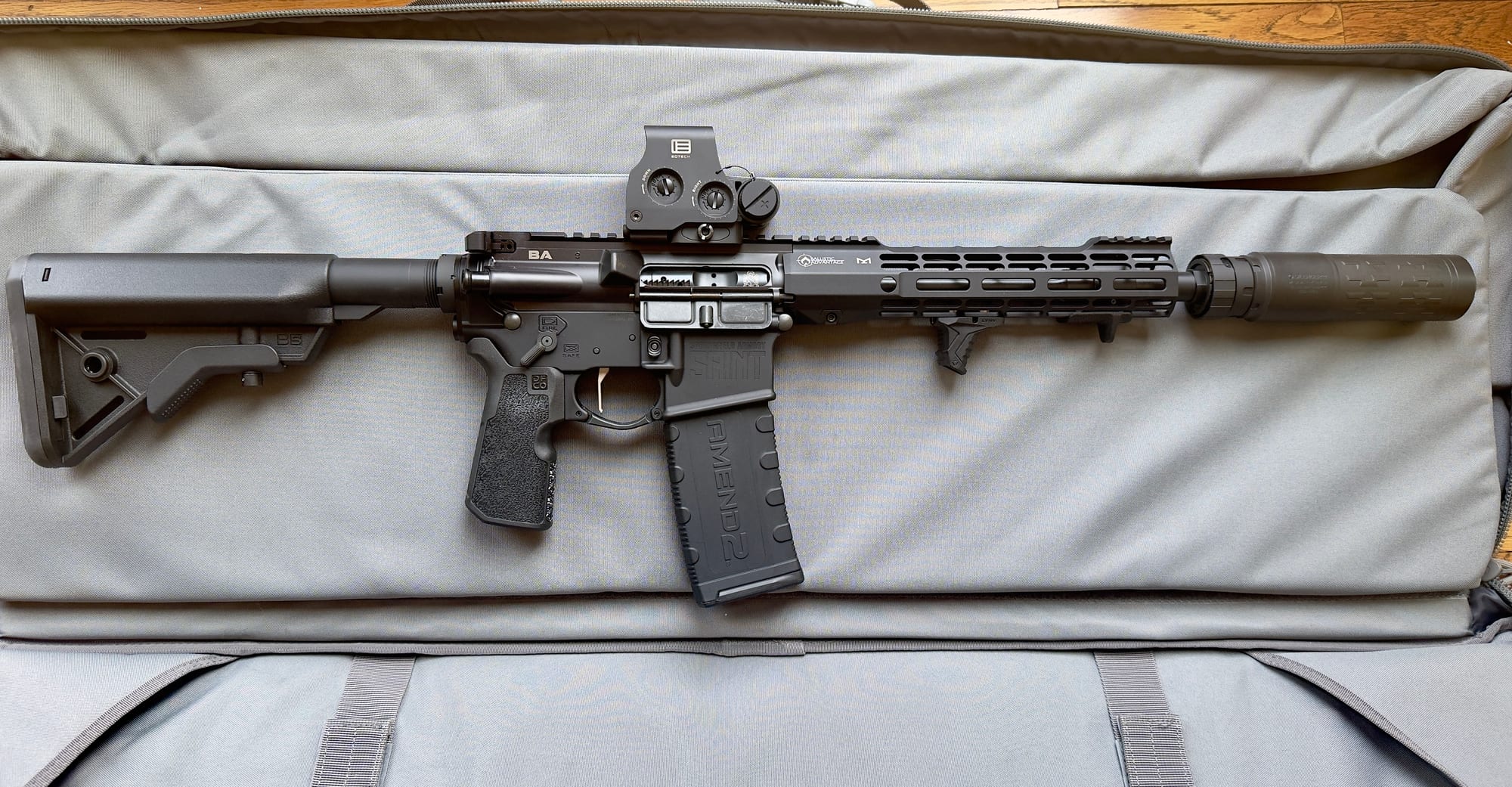
The only downside of an SBR is the paperwork
I went looking for the knock on this rifle and kept coming up empty, because the thing I would warn you about is not the rifle.
Functionally, there is no downside to turning an AR pistol into an SBR. Take the same gun, change nothing but the brace for a stock, and you lose nothing except the price of the stock. The stock is a better fit, it has less wobble, it is more rigid, and it is exactly what you want behind a short barrel.
The downside is the process. You file a Form 1 and wait. Then the receiver has to be engraved, which means finding a gunsmith you trust and paying for it. Mine was about $100 and took about an hour. That is the real cost of an SBR: not the rifle, the hassle and the expense of being allowed to put a stock on it.
There is talk that the engraving requirement could go away. If it does, this gets cheaper and easier, and waiting for that would be a reasonable thing to do. I would not bet on a date.
From AR pistol to SBR: what it started as
This began life as a Springfield SAINT Victor 5.56 pistol, the STV975556B-B5: a 7.5-inch barrel, B5 Systems furniture, and an SB Tactical SBA3 brace. It is an early version Springfield no longer makes.
The 7.5-inch barrel was super easy to maneuver for home defense and close quarters. That was the good part.
The bad part was that it was FREAKING LOUD. Every indoor range session without a suppressor, even with hearing protection, I came away with a headache. The concussive blast was heavy on my body in a way I have never felt from any other gun. And I kept thinking about the night I might actually need it. Fired inside the house, without hearing protection and without a suppressor, it likely would have left my entire family with permanent hearing damage.
So I wanted a suppressor on it, and the gun would not take one. The handguard ran out past the barrel's threads, and it was too skinny for a can to fit underneath. Fixing that meant changing the barrel, the handguard, or both. At that point a whole new upper made more sense.
There was one more thing. With that short a barrel the bullet never got up to the velocity it wants, and I could see it: the drop was more pronounced even at short distances. I never put a chronograph on it, so that is what I saw, not a number.
A new 10.5-inch upper, while the Form 1 was pending
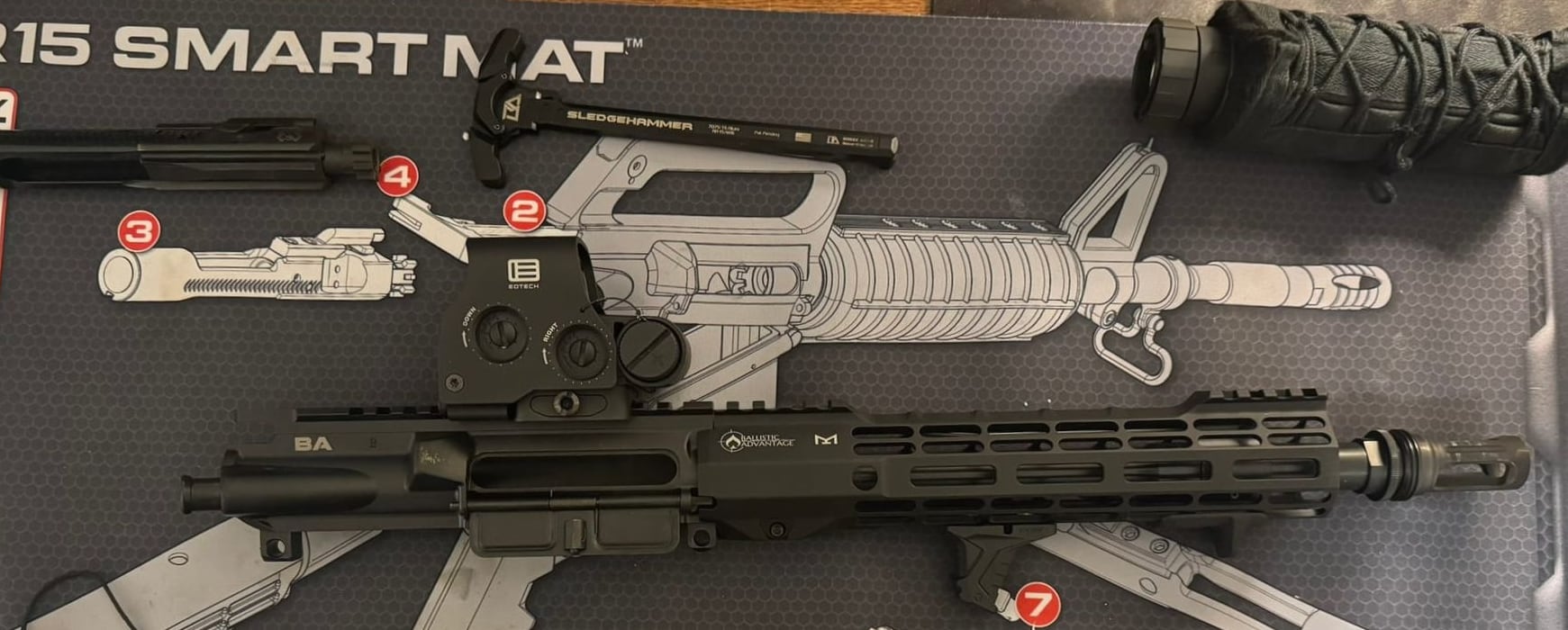
I filed the Form 1 on April 10, as a braced pistol. While it was pending, I put the new upper on. It was still a pistol with a brace, just a better one, and from early May it wore the Velos.
The upper is a Ballistic Advantage 10.5-inch 5.56 with a 9-inch S-One M-LOK handguard. I looked at a bunch of uppers Palmetto State Armory sells, and I seriously considered an 11.5-inch. If this were my only rifle, maybe someone could have talked me into the longer one. But I already own a 14.5-inch, a 16-inch and a 20-inch AR, so going shorter here was easy. I am happy with the 10.5.
The handguard is the right length for the barrel. It leaves enough barrel out front for the threads, and the can goes on with no clearance problems, which was the entire point. It has Picatinny rail at the front and rear of the top, none in the middle, which trims weight, and a built-in QD sling point.
I carried the original Springfield bolt carrier group over to the new upper, along with the Breek Arms Sledgehammer charging handle. There were no fitting issues with either.
The Form 1 paperwork: filed, approved, engraved
This is the part you came for, so here it is plainly.
- –How I filed: eForm 1, through my trust. The same trust and setup as my Velos.
- –Filed: April 10, 2026.
- –Approved: July 1, 2026. That is 82 days.
- –Engraving: done by the gunsmith at Georgia Firing Line, my local range and gun shop. Trust name, city and state. It took about 60 minutes, which I spent shooting in their range, and I think it was about $100.
- –Then the stock. I put it on within about five seconds of the gunsmith handing the rifle back.
The order matters, and it is the part people get wrong. The brace stayed on until the stamp came back. Until the Form 1 was approved for this specific build, a stock would have put me out of compliance with the NFA. Once it was approved, the stock was legal, and it went on the same day as the engraving. That is what I did, not legal advice. If your situation is different, check before you do anything.
Your wait will not be my wait. Where the Form 1 lanes stand right now is below, and it updates on its own. For the full picture, see current SBR wait times, and if you are deciding how to file, trust vs. individual. Waits have gotten meaningfully shorter since I filed, which is the best argument for doing this now.
Why swap a pistol brace for a stock
The number one reason to convert is simple. A pistol brace is flimsier than a purpose-built stock.
The B5 Systems Bravo is solid. No wobble, a good cheek weld, and no trouble getting the same sight picture through the holographic every time. I did not get the version with the extra cushioned buttpad and I do not think I need it. A Magpul CTR would probably do the same job for a little less money, and the choice between them is mostly taste.
How the 10.5-inch SBR runs
Since the conversion I have put roughly 400 to 500 rounds through it as an SBR, from 55 to 69 grain, and it has not had a single malfunction. It has run everything I have fed it.
Unsuppressed, it is still loud, but better than the 7.5-inch ever was. Suppressed, I have no complaints about the sound. A 5.56 is never going to be quiet the way a 300 Blackout can be. What matters to me is that I do not go home with a headache anymore.
Gas is the honest caveat. Between the Breek Arms charging handle, which is built to divert gas, and the low back pressure Velos, I do not notice gas on a few rounds, especially outdoors. Run a heavy string of rapid fire indoors and a little comes back. It does not bother me or my eyes, but it is not zero.
The trigger is the factory Springfield nickel boron flat trigger, and I like it. It has a very crisp break and practically no take-up.
On accuracy, I have bench-rested it once at 100 yards with factory ammo and a 1x holographic sight, and it held about 3 to 4 inches. That was better than I expected from this setup, and it is not a precision test. I shoot this rifle standing, unsupported, and sometimes moving. It is not built for sub-MOA from a bench.
What is on it
- –Optic: an EOTECH EXPS3-0, bought at retail in 2021, with no magnifier. It is the same EOTECH I mentioned in the Defender-CCW review, the one I bought because I was told holographics handle astigmatism better. I still see some bloom through it.
- –Suppressor: the SilencerCo Velos LBP 5.56 on the ASR closed-tine flash hider that came in its box. That review covers the can, the mount, and the cover in full.
- –Charging handle: the Breek Arms Sledgehammer. It went on the same day as the Velos, so I cannot tell you how much of the gas improvement is which.
- –Grip: the Die Free Co Kung Fu Grip, in place of the original B5 grip. The angle is different from most grips, and if you have thousands of rounds on a traditional mil-spec grip it may feel odd. I like it. Maybe I fell for the marketing, but the angle suits the length of pull I run on this rifle, and the texture never feels slippery, even sweating, without being harsh bare-handed.
- –Handstop: a Strike Industries Mini HandStop, mid-handguard on one M-LOK slot. It is small and low profile and gives my support hand something to pull back against. Its big feature is cable management, which I do not use, because I do not run a light or a laser. I sometimes wonder if it is slightly undersized, and whether I would have liked one of Strike's larger versions better.
10.5-inch SBR vs. my 14.5, 16 and 20-inch ARs
The 20-inch precision build is heavy, wears a heavier zoom optic, and is capable of very tight groups at distance. It has a fixed stock and it cannot do close-quarters work at all. The 10.5 is way lighter and way easier to handle in tight spaces, and it fits in a truck or a trunk.
The 16-inch, a Palmetto State Armory, is a solid all-rounder, close to a Goldilocks rifle that can do it all. It also does not excel at anything in particular.
The 14.5-inch, a Bushmaster, has practically no downsides. It probably gets a bit more velocity and a bit less drop, although I have never measured either, and it has more rail for accessories. I keep my rifles minimal, so the extra rail does not do much for me. For close quarters, the 10.5 wins.
What I didn't test
Past 100 yards. Never. That is not what this rifle is for. I have other ARs with longer barrels and magnified optics for that.
Real accuracy. One bench session at 100 yards, factory ammo, 1x optic. No match ammo, no handloads, no precision testing.
Velocity. I have never put a chronograph on it, so everything I said about velocity and drop is what I saw, not what I measured.
Who should do something else
If the brace has never bothered you, there may be no reason to change. If you have never shouldered a real stock on a short barrel, though, you may not know what you are missing, and ignorance can be bliss.
If the hassle is what stops you, you could wait and see whether the engraving requirement goes away. I would not wait on it. It is speculative, and the waits are already shorter than when I filed.
If you already own a pistol you like, the only real costs are the paperwork, a stock (worth it), and the engraving. Heck yeah, I would do it again. No regrets.