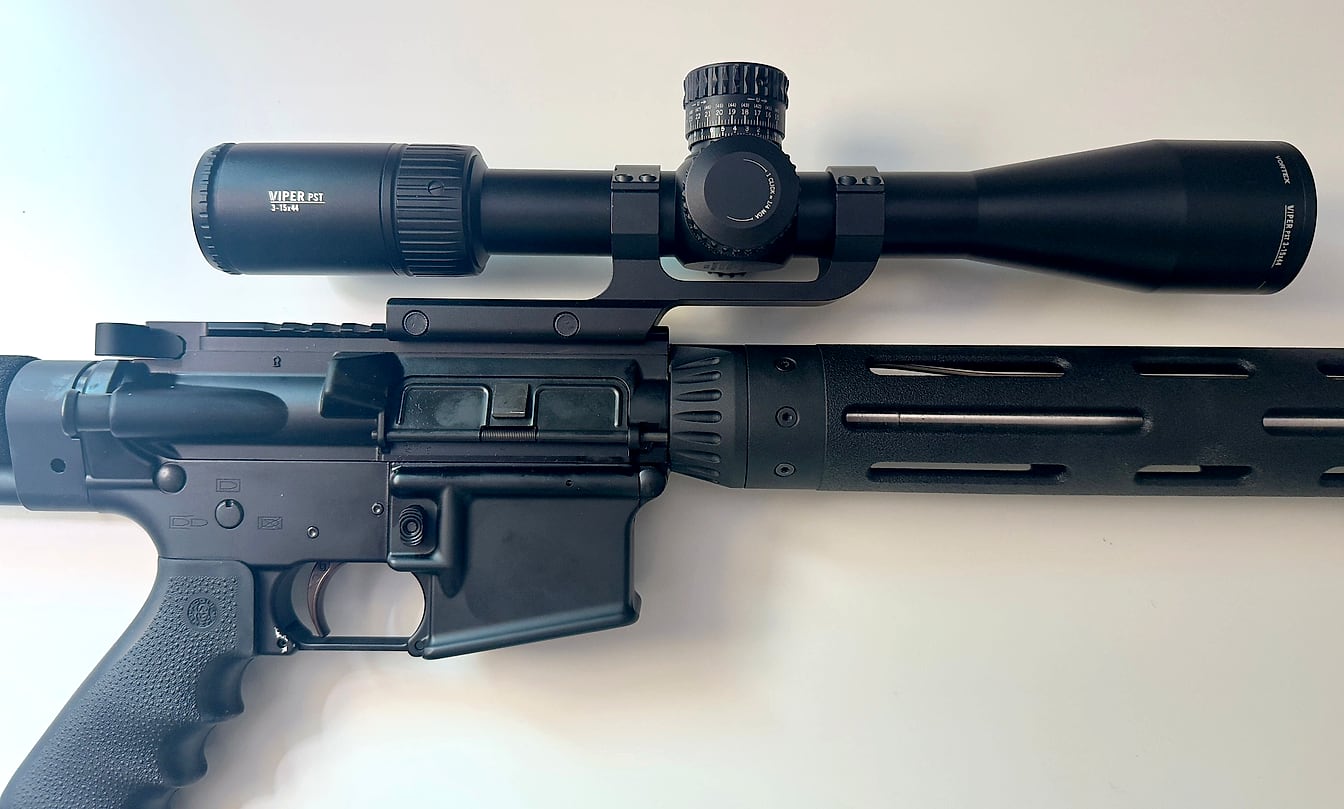
Two reasons to put this one back on the shelf
The first is the one that will actually apply to most people reading this, and it has nothing to do with whether the scope is good.
This is a scope for a rifle that changes distance. It has an exposed elevation turret you are meant to dial, and a hash-marked tree in the reticle for holding over and holding wind. If your rifle lives at one distance, say a hunting rifle or a 100-yard range gun, you are paying for machinery you will never touch. A Leupold VX-3HD 3.5-10x with a plain duplex would serve that rifle better, cost you less, and weigh less on the gun. I am not being modest about the Vortex. I am saying this thing leans tactical, and if you are not dialing and not holding over, that lean is just weight.
The second is smaller and it is mine to complain about. Setting the return-to-zero is more tedious than it needs to be. To get the zero stop where you want it you pull the turret cap completely off and work three separate hex screws across the cap and the turret itself. It works, and once it is set you never think about it again. But I have used scopes that cost meaningfully more and made that job easier, and I noticed.
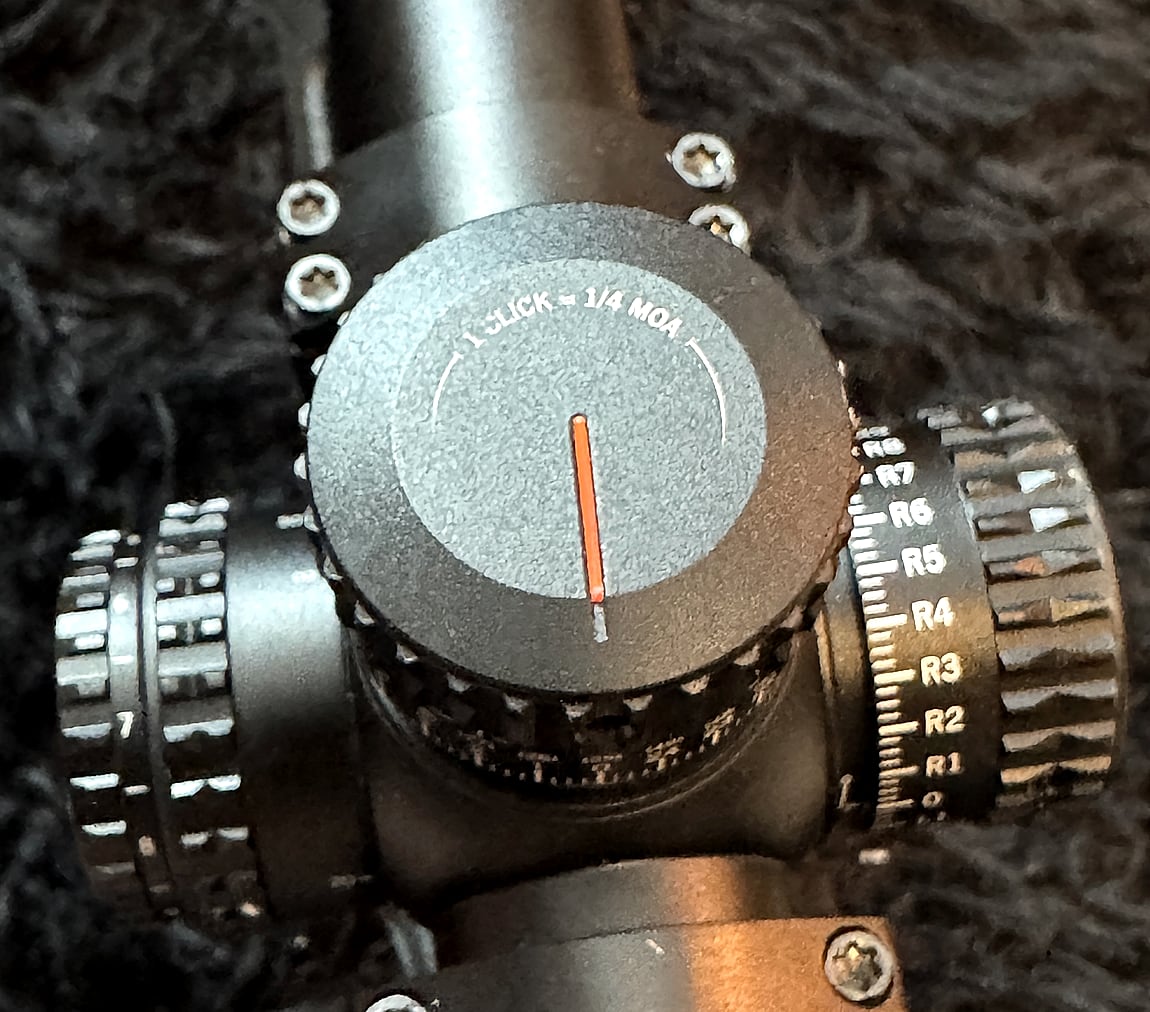
While we are looking at that photo, there is my third complaint, and it is entirely a preference. I was sent the MOA model. I would have taken the MRAD.
What I have not done with it
I should put this near the top rather than bury it in a list at the bottom.
Every round I have fired through this scope has gone 100 yards. That is the maximum at the range I have been shooting, and it is not nearly far enough to test the thing this scope exists to do. I have not dialed it for a 600-yard shot. I have not held wind at distance with the tree. I have not confirmed that it tracks true across a lot of elevation and comes back to zero afterward, which is the single most important thing a scope like this has to do.
So take everything below as what 138 rounds at one distance can tell you, and nothing more. When I get it out past 100 yards I will add what I find to the bottom of this page rather than quietly editing the middle of it.
Why I asked for this one, and what it actually costs
I wanted it for a precision AR build, and it was on my own short list before Vortex offered the loan. That is still true now that I have shot it.
What I cross-shopped is more useful to you than why I liked the name. The Vortex Strike Eagle 3-18x is several hundred dollars cheaper and gives you more magnification on paper. The glass is not the same, and I will admit I would still consider one for some jobs. On the other side, the Leupold Mark 4HD 4.5-18x52 gives you a bit more range and a reliability reputation I take seriously. At the bottom, Arken's 4-16 FFP is a genuinely surprising amount of scope for the money.
Here is the part that changes the decision, and I am dating all of it because it will go stale. Vortex lists the first focal plane version at $1,349.99. The Leupold Mark 4HD lists at $1,499.99. That is a $150 difference on paper, and at those numbers you would call them the same class of purchase and pick on features.
Now look at what they were actually selling for. In September 2026, OpticsPlanet had this scope at $769.99 in MOA and $879.99 in MRAD, and the Leupold at $1,389.99.
Work out what that means, because I did not expect the size of it:
- –The Vortex was $580 off its own list price, a 43 percent discount. In MRAD it was $470 off, about 35 percent.
- –The Leupold was $110 off, a 7 percent discount.
- –So a $150 gap at list becomes a $620 gap in a shopping cart.
- –Put another way: at list the Leupold costs 11 percent more than this scope. At street it costs 81 percent more.
That is the same two products and a completely different decision. If you compare these on the numbers the manufacturers print, you are comparing two scopes that cost about the same and you will choose on reputation, which sends you to Leupold. If you compare what you would actually hand over, you are deciding whether a set of features is worth nearly doubling your money.
I want to be careful about what this does and does not prove. It is one retailer on one day, and I have not tracked either price over time, so I cannot tell you this is a permanent state rather than a moment. What I can tell you is that it was not a sale tag or a coupon, it was the shelf price, and the Vortex has been discounted hard and the Leupold has not. Check both yourself before you buy either. The point is not the exact figures, it is that on this pair of scopes the list prices are close to useless for deciding.
One trap to avoid while you check. The 3-15x44 comes in two focal planes, they are separate products, and they are priced differently. The cheaper one you will find is the second focal plane at $1,199.99 list. This review is the first focal plane, the one where the reticle scales with magnification, and it is the more expensive of the two. I got caught by exactly this while checking my own numbers for this review.
That gap is the reason I would buy this scope, and it is not a reason that shows up on a spec sheet.
The rifle, and the day that told me the most
It lives on a BCM 20-inch SAM-R, 1:8 twist, with a Geissele SSA-E and a fixed Ace skeleton stock. It has not been on another rifle and it is not going to be. This is more scope than a short-barreled gun needs, and my .308 already wears something with more magnification.
I laser bore sighted it, zeroed at 25 yards, moved to 100, and stayed there.
The 138 rounds break down into about 30 getting it zeroed and fouling the barrel, and 108 on September 19 shooting a load ladder: 36 groups, three shots each, across four bullets. Sierra 52 grain Match King, Hornady 55 grain, Sierra 69 grain Match King, Sierra 77 grain Match King. None of it was fast. Every group was deliberate, no time limit, trying to shoot as small as I could.
That day is the most useful thing I can tell you about this optic, and not for the reason you would expect.
Started at 9:35 in the morning at 78 degrees, slightly windy, not still. Mostly overcast, though the clouds broke and put real sun on the target a few times, so I did get to see it in more than one light. What I figured out later, looking at the numbers, is that the wind was doing more to my groups than the powder charge was. 24 of my 36 groups came in wider than they were tall. I could not have told you that at the bench. What I can tell you is that the glass was never the reason I was unsure about a shot. When I missed my call I knew why, and it was not the scope.
The glass, and the eye relief I was wrong about
I was worried about eye relief when I first mounted it. It felt tight setting the gun up in the house, and I spent a while convinced it was going to be a problem.
It was not. Once I had practiced a cheek weld I could repeat, and learned where my eye actually needed to be, it stopped being something I thought about. By the end of the first session I was not thinking about it at all. I am putting this in because the in-the-house impression and the on-the-rifle reality were different, and if I had written this review after an evening at the kitchen table I would have told you the wrong thing.
The eye box follows the same shape. At low magnification it is forgiving and I never fought it. At a full 15x it took me a bit to find the head position that works, and now it is muscle memory and I have no complaints. That is a real cost if you are switching between rifles constantly. On a rifle you shoot the same way every time, it disappears.
On the glass itself, I am impressed with the clarity for what this costs. I focused the eyepiece early to get the reticle crisp and have not touched it since.
⛔ There is no photograph of the view through this scope on this page, and there is not going to be one. My phone cannot hold the exit pupil no matter how I brace it. That is worth explaining rather than leaving as an absence, because a phone-through-a-riflescope photo is not evidence about glass anyway. The camera cannot see what an eye sees, so those photos make good optics and mediocre optics look about equally mushy. A picture like that would tell you less than the paragraph above it.
Dialing it
The parallax adjusts from the left side and the yardage marks on it have felt true to the actual distances I was shooting.
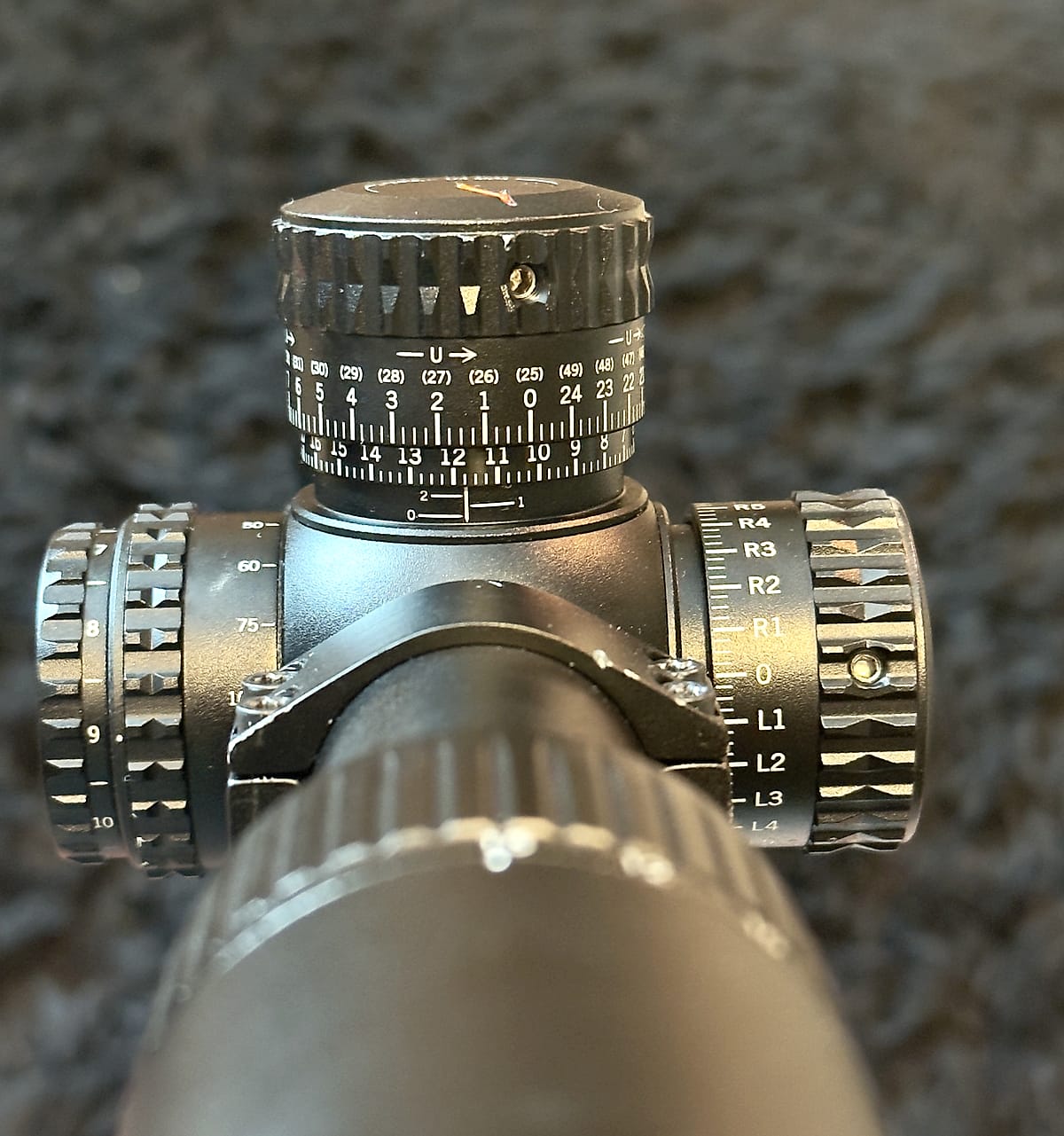
Turret feel is worth separating into two answers, because I got two. While I was setting the initial zero with the cap off, the adjustment was smooth and quiet rather than crisp, and there was no audible click to count. With the cap back on and its screws tightened, it turned into a very positive, crisp adjustment. So if you take the cap off, set your zero, and think the turrets feel mushy, put it back together before you judge them.
It has held zero through everything I have done to it, which I will caveat properly below.
The illumination is manual, with a detent for off between every brightness level. I like that more than I expected to. You are not cycling from nothing up to the setting you want and overshooting it. You go one position and you are on, one more and you are off again. The battery is a CR2032 and it lives on the same knob as the parallax.
Mounting it
Vortex did not send a mount with the loaner, so this is running in a 30mm Primary Arms cantilever I already had in a drawer. If you are pricing this scope, price a mount with it.
It went on without any drama. I set it up nose to charging handle, which is what works for me on a fixed stock rifle, and nothing has moved since.
Cleaning is not really a category here. It has needed nothing. If it ever does, it is a microfiber wipe. It ships with basic flip caps.
What I did not test
Anything past 100 yards. Said above, said again here, because it is the big one. Every claim on this page comes from a single distance.
Tracking and return to zero across real elevation. I have not dialed a large correction and come back. A box test is the standard way to prove that and I have not run one.
The tree at distance. I have not held over or held wind with the reticle in a situation where being wrong would have shown up on paper.
The view through the glass, photographically. Explained above. You are taking my word on the glass, and I would rather say that plainly.
Durability. It is a 60-day loan. Nothing here is a durability verdict.
Cold, wet, or hard use. It has been shot on nice days from a bench.
Compared to what I already own
On price, the Arken. I own a 7-35x and it delivers for what it costs, and their 4-16 FFP was under $300 in September. The eye box is less forgiving and you feel that after a couple of hours, but on dollars it is not close. On reputation, the Leupold Mark 4HD, which I have not shot. I have had medium grade Leupolds on hunting rifles for a long time and not one of them has ever failed me. If I were buying something I had to trust in bad conditions and money was not the question, I would look hard at it. Money is usually the question.
Against a plain 3-9x, this is not really a comparison. You are buying the ability to change your solution without changing your hold, and a fixed-power hunting scope is not offering that.
Is it worth adding if you already own something decent? Depends on what you own and what you want it to do. If you have a good hunting scope on a hunting rifle, a VX-3 or a VX-4 with a duplex, this is not an upgrade to that rifle. It is a different job. Leave the hunting scope where it is and buy this when you build the rifle that needs it. If what you own is a budget FFP that you like fine, the jump in glass is real and you will see it, but you are paying two or three times the money for it. That is a legitimate upgrade. It is not a rescue.
Where this leaves me
The scope goes back to Vortex when the loan is up.
I would not pay list price for it. At what it was actually selling for in September I would, and if I can find the MRAD version in stock that is the one I would buy. That is a specific enough position that you can check it against me later, which is the point of saying it that way instead of just saying I liked it.
The thing I keep coming back to is the day with the ladder. Thirty-six groups, four bullets, a long slow morning where every small annoyance has time to surface. The list of things I was fighting that day has wind at the top of it and the scope nowhere on it at all.
I still want to shoot it at distance before I tell you it is a distance scope.