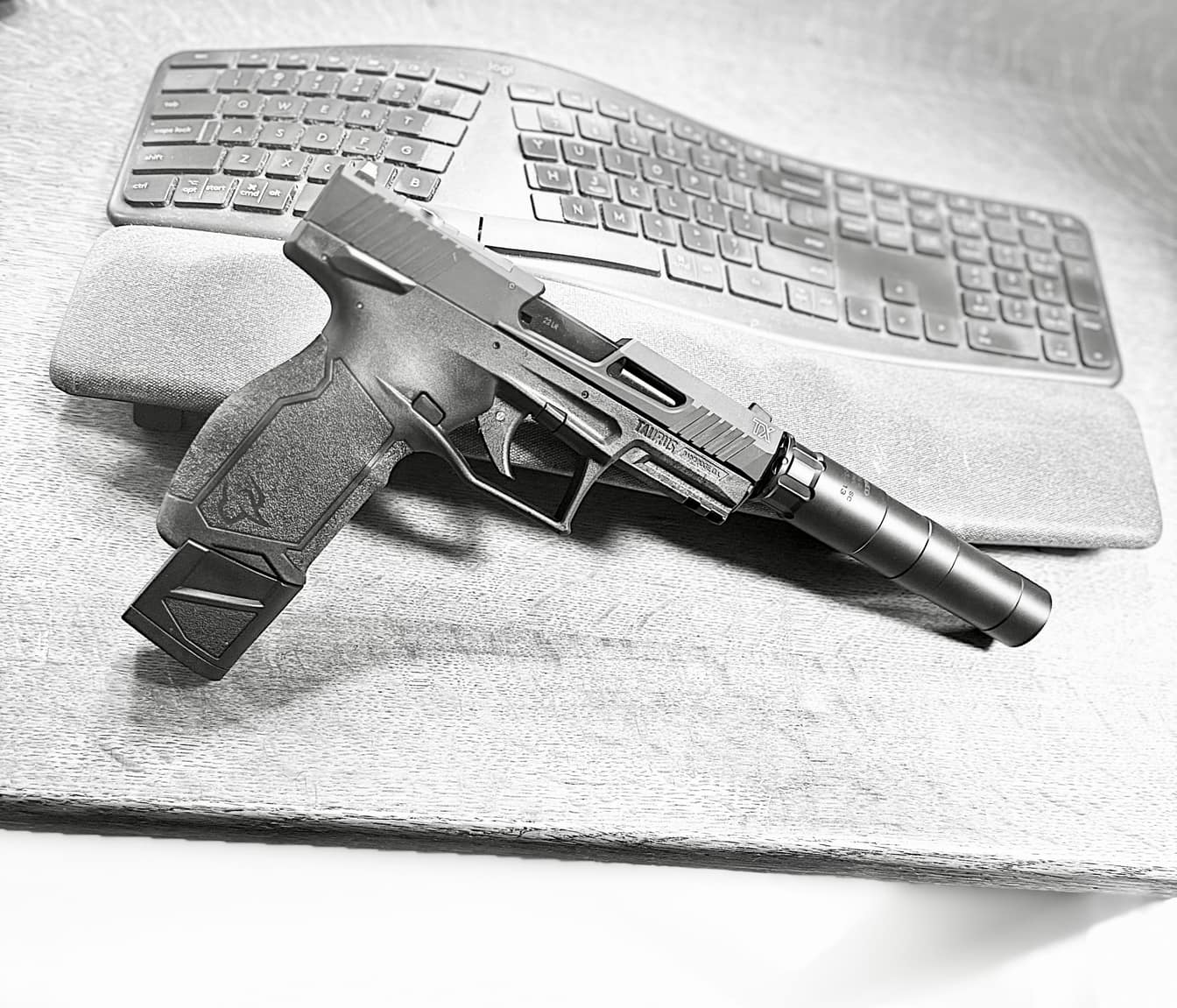
Start with the part that should give you pause
There are plenty of genuinely good .22 cans that cost less than this one, and I'm not going to pretend otherwise. The SilencerCo Sparrow has been around forever and has the warranty and customer service record to match. Resilient Suppressors' Jessie's Girl comes in an aluminum version at a fraction of the weight, if you can live with .22 LR only. And Griffin Armament's Resistance22 will take 5.56 — with a blast shield, on a 16-inch barrel, in short strings with a cool-down — which is versatility the Oculus22 simply doesn't offer.
The other thing, and this one is entirely a matter of taste: it's a plain-looking suppressor. Manufacturers are doing genuinely interesting things with design right now, and this isn't one of them. I happen to like how it looks. You might find it boring, and you wouldn't be wrong.
So if you're talking yourself into the most expensive option on your list, here's your permission to stop reading. You could find something cheaper that's nearly as good.
Why I bought it anyway
I cross-shopped two cans seriously. The Sparrow 22, because it's the tried-and-true answer and has been for years. And the Dead Air Mask HD, which I liked, but which doesn't give you the modularity.
What tipped me was reputation for reliability. Full stainless construction, full-auto rated, and an unconditional lifetime warranty behind it. This thing is a tank, and I was willing to pay up a bit for the peace of mind that comes with that.
I should also admit the unglamorous part: it was in stock at my dealer, and the others would have had to be ordered. I was already leaning this direction, so that wasn't the decision — but it was the reassurance that let me stop deliberating.
Two months on, I'm 100% satisfied. Would I have been just as happy with one of the others? Possibly. But I have zero regrets and no buyer's remorse, which is not a sentence I get to write about every purchase.
The TX22 is the whole reason this is fun
It lives on a Taurus TX22 TORO, and it has never come off for any reason other than transport.
I've run a mix through it — standard CCI, CCI subsonic, Federal bulk from the value pack, Winchester Super-X, Remington Golden Bullet. About 500 rounds total. One failure to feed in all of that, on a cheap bulk round that physically looked a little off when I found it. I'm not prepared to call that a system problem.
Shooting it is the most fun I have at the range. No recoil to speak of, quiet, accurate, and cheap enough per round that there's no reason to stop. It puts you right back to being a kid with a .22, plinking, not wanting to go home. That's not a performance claim. It's just why the gun stays loaded.
It's also the best tool I own for handing to someone who has never shot before. No frightening noise, nothing to flinch at, easy to hold. You can put a new shooter behind it and watch them enjoy themselves instead of enduring it. What I actually say at the range is some version of "come over and give it a try."
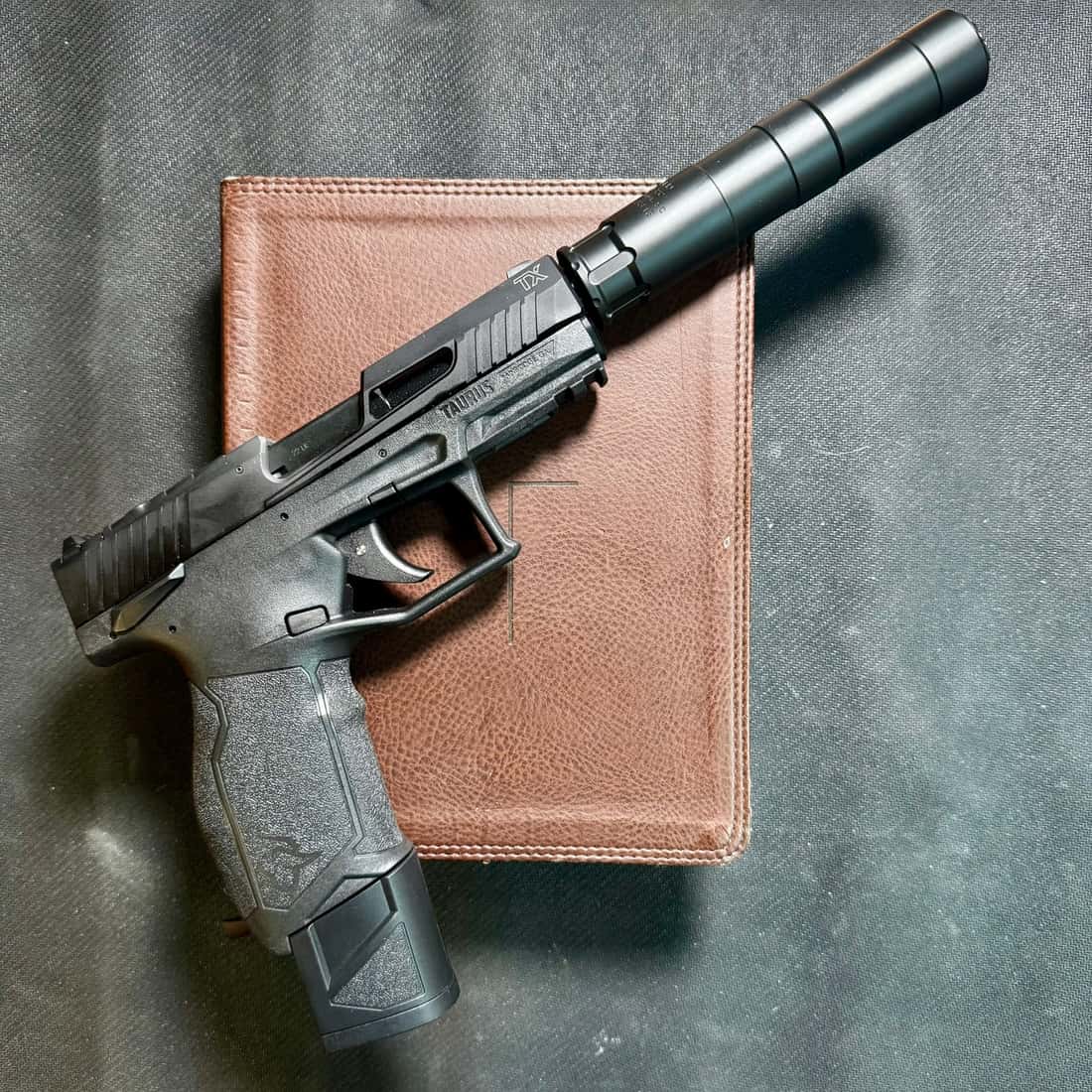
One thing genuinely surprised me. On paper the package looks long for a pistol — full-size can hanging off the end of a TX22. In the hand it never felt obnoxious, and it didn't handle meaningfully differently than the bare pistol. I expected to be annoyed by the length and I never was.
I've also shot a range rental Sig P322 that had a can on it. I don't know what brand, and I want to be careful here, because I was changing the pistol and the suppressor at the same time — I can't tell you how much of the difference was which. What I can tell you is that the rental setup felt generic and mine felt premium. And I wanted to like the Sig. My EDC is a P365 Fuse, so the familiarity would have been worth something to me. The Taurus won anyway. Smooth as butter.
What it actually sounds like
First-round pop: I've got nothing. If I told you I heard one, I'd be convincing myself it existed because it's supposed to, not because I heard it. Shot one and shot two sounded the same to me.
Rugged publishes "no first-round pop" for the full-length configuration. Of everything on their spec sheet, that's the only claim I'm in any position to comment on, and as far as my ears can tell, it holds.
The tone is soft and pleasant. Not sharp, not loud, nothing that makes you tense up before the trigger breaks. About as close to movie-quiet as we're going to get in real life.
The subsonic ammo is quieter, and I mostly save it for when I want to impress a guest. That's the part worth knowing if you're budgeting: cheap bulk standard-velocity ammo is already soft and pleasant through this can. You don't have to feed it expensive ammunition to enjoy it, which over a few thousand rounds matters more than most spec-sheet differences.
No gas in the face either, and I don't want to hand the can credit it hasn't earned. The TX22 is a straight blowback pistol held out at arm's length — not a direct-impingement rifle routing gas back down a tube toward your cheek weld. That's where the suppressor-gas complaints come from, and it's an AR problem far more than a rimfire one. Nearly every .22 semi-auto is blowback, my 10/22 included, so threading that barrel won't answer the question either. I got none. It just isn't the test people mean when they ask.
I did shoot it in the short configuration, and I could hear the difference. Long is better. Short is still dramatically better than no suppressor at all — no question there — but if I have the choice, and I always do, I'm shooting it full length.
The modularity I paid for and have never needed
This is the finding I did not expect to write.
The modular length was a real part of why I chose this can. Short at 3.25 inches, full-size at 5.25, swap depending on whether I'm shooting rifle or pistol and how much quiet I want to trade for maneuverability. It sounded useful. It sounded like the reason to pay more.
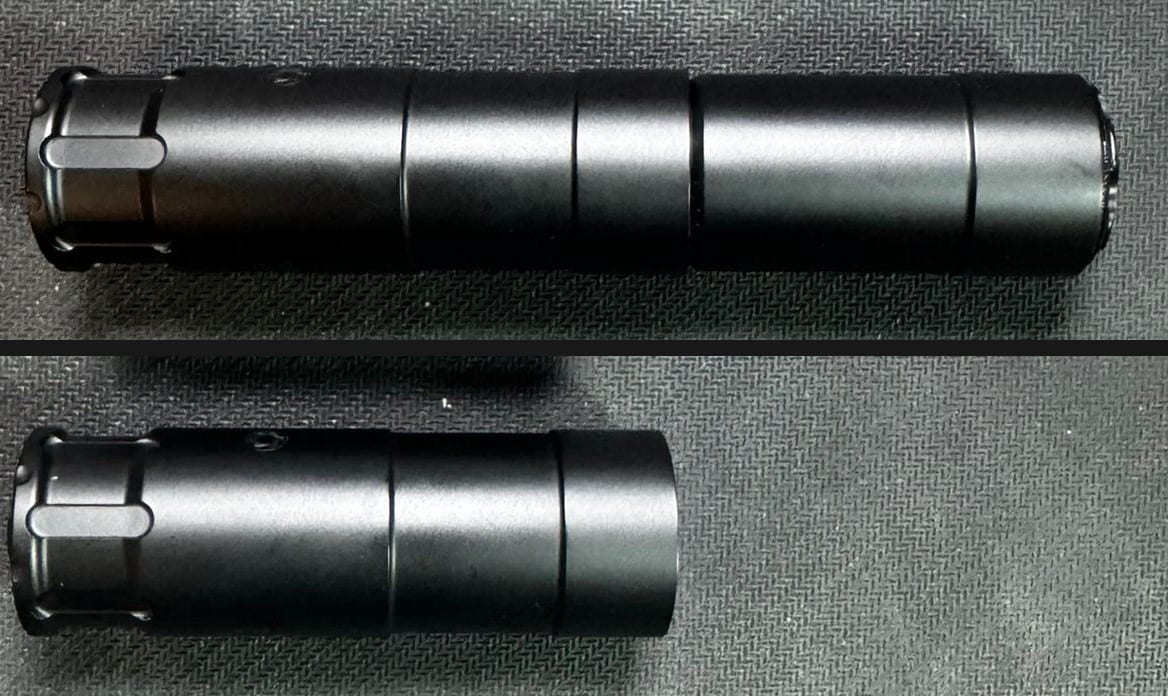
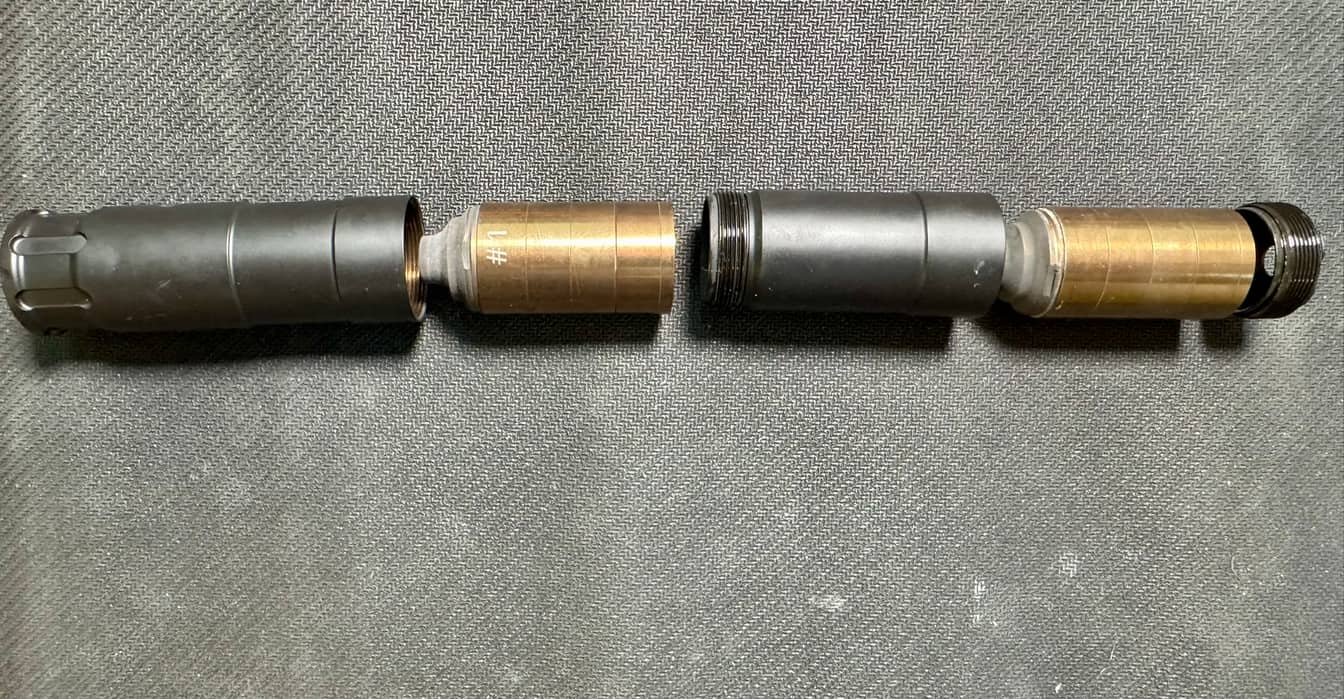
I keep it in long mode. It's a little quieter that way, and the weight and length have never bothered me. I have swapped it far less than I assumed I would, and I don't expect that to change.
I want to be fair about this. If the modularity is free — if you're paying the same as you'd pay for a comparable fixed-length can — then it's a nice option to have in your pocket. But I'm not going to tell you it's earning its keep for me. If Rugged sold this exact suppressor in full length only, I would still be thrilled with it.
Living with it
I expected a rimfire can to be disgusting. I clean my guns after every single range visit, so I went in braced for it.
It isn't spotless. It also wasn't dirty enough, after 500 rounds, for me to feel like I needed to do anything about it — and that's coming from someone with an established habit of over-cleaning. Take that as an early data point, not a durability verdict.
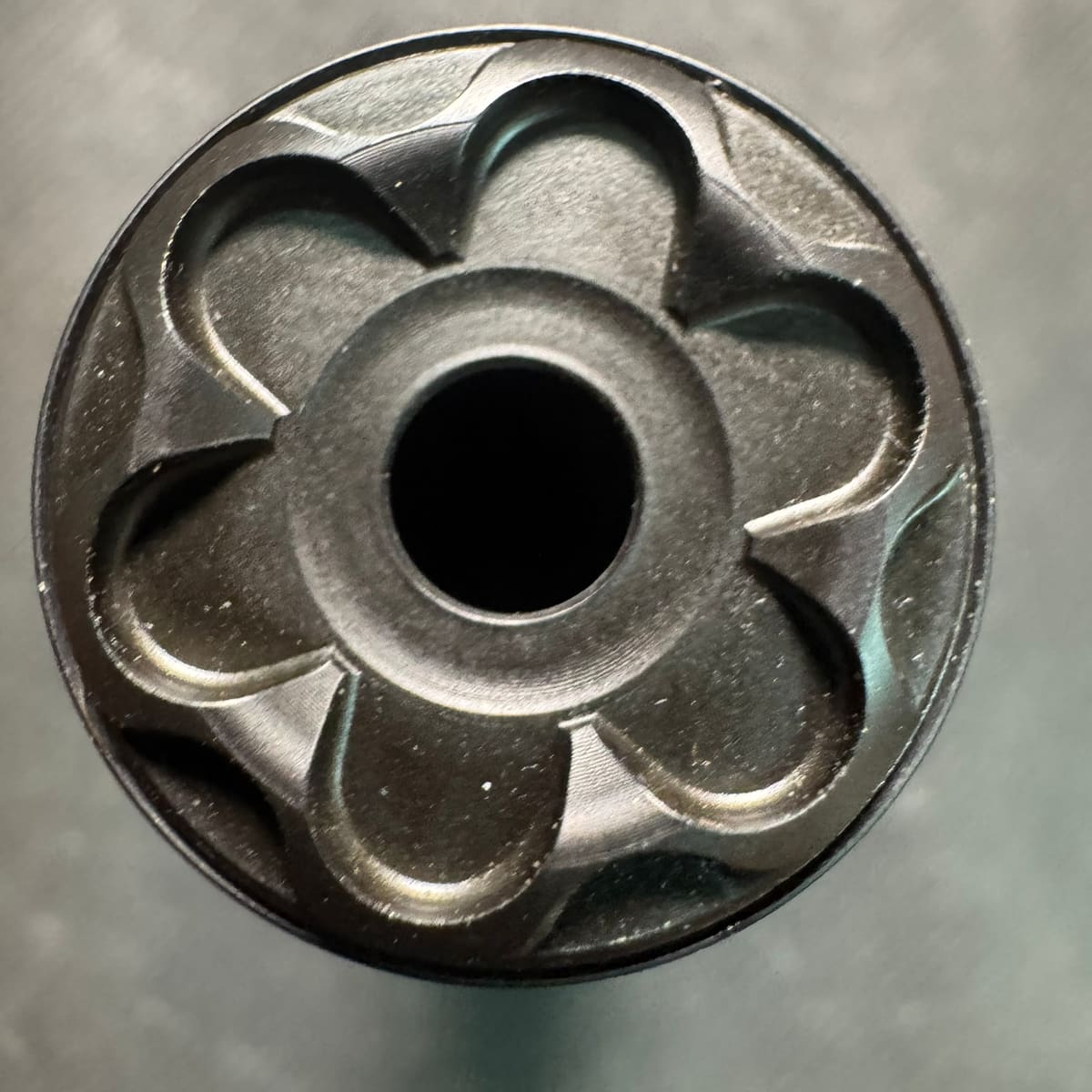
Disassembly is easy. The provided tool takes the front cap off and it twists in half to split modularly. Nothing has seized, nothing has needed force, nothing has worn or discolored or loosened. Direct thread on and off, no fit issues.
While I'm here: the machining is genuinely good. I didn't set out to write a paragraph about fit and finish, but every time I take the front cap off I notice it again — the threads run smooth, the edges are clean, nothing about it feels like it was made down to a price. That's a subjective judgment and I'm not pretending otherwise. It's also most of what "this thing is a tank" meant when I said it.
It gets hot. Nowhere near what a 5.56 can does, but I wouldn't try to unscrew it bare-handed after a session — a glove or a hot pad, and then it cools off in a reasonable amount of time.
The one thing that genuinely annoys me isn't the suppressor's fault: my case isn't big enough to transport the gun with the can attached. So every trip involves pulling it, and every trip home involves the same in reverse. It's a 30-second job to swap the thread protector and direct-thread the can, so calling it a hardship would be dishonest. I probably just need a bigger bag.
What I can't tell you
I don't own a meter. Every sound judgment on this page is my own hearing, made while wearing ear protection, which is how I shoot and how I'd recommend you shoot. That means I can tell you what's pleasant and what isn't, and I cannot give you a number or defend one.
I've never run it on a rifle. Everything above is pistol-only. That's changing — I enjoyed this enough that I'm having my gunsmith thread the barrels on my Marlin and my 10/22 — but as of today I haven't done it, so I'm not going to guess at how it behaves on a rifle-length barrel.
I've shot exactly one other suppressed .22, it was a rental, and I don't know what can was on it. That is not a comparison, and I'm not going to dress it up as one.
Two months and 500 rounds is early. Nothing has gone wrong, and nothing going wrong this soon is what should happen. Ask me again in three years.
Who should buy something else
If you want light, look at the Rugged Mustang22 or the Banish 22 — titanium and aluminum, and that's a real difference you'll feel. If you want the budget pick, the YHM Phantom or the Sparrow. Griffin Armament's rimfire line seems to do well on sound, maintenance, and materials for the money, and the Checkmate-HD in particular looks like the sweet spot in the budget-plus tier — though note that one tops out at 5.7×28. The Resistance22 is the model to look at if the 5.56 rating is what you're after.
And here's the part I'd say to a friend. If you already own a decent .22 can, you almost certainly do not need this one. The industry keeps iterating and there are improvements out there, but they're incremental. If money is tight, don't spend it on a second rimfire suppressor — buy more ammunition, or buy training. You'll get more out of either. If you have room in the budget and you want to grow the collection, that's a different conversation and I'm not going to talk you out of it.
The paperwork
I filed as a trust on 12 April 2026 and had approval on 21 May — 39 days.
In hindsight, filing as an individual probably would have been faster, and I could have transferred into the trust afterward. I went the one-step route for simplicity, because I knew I wanted it held in a trust long-term. I'd probably make the same call again, but I'd make it knowingly rather than by default.
Where those lanes stand today is below, and it updates on its own.